
Continual learning for science: a third component of the AI stack, beside the model and the harness, with its own state and its own learning rules.
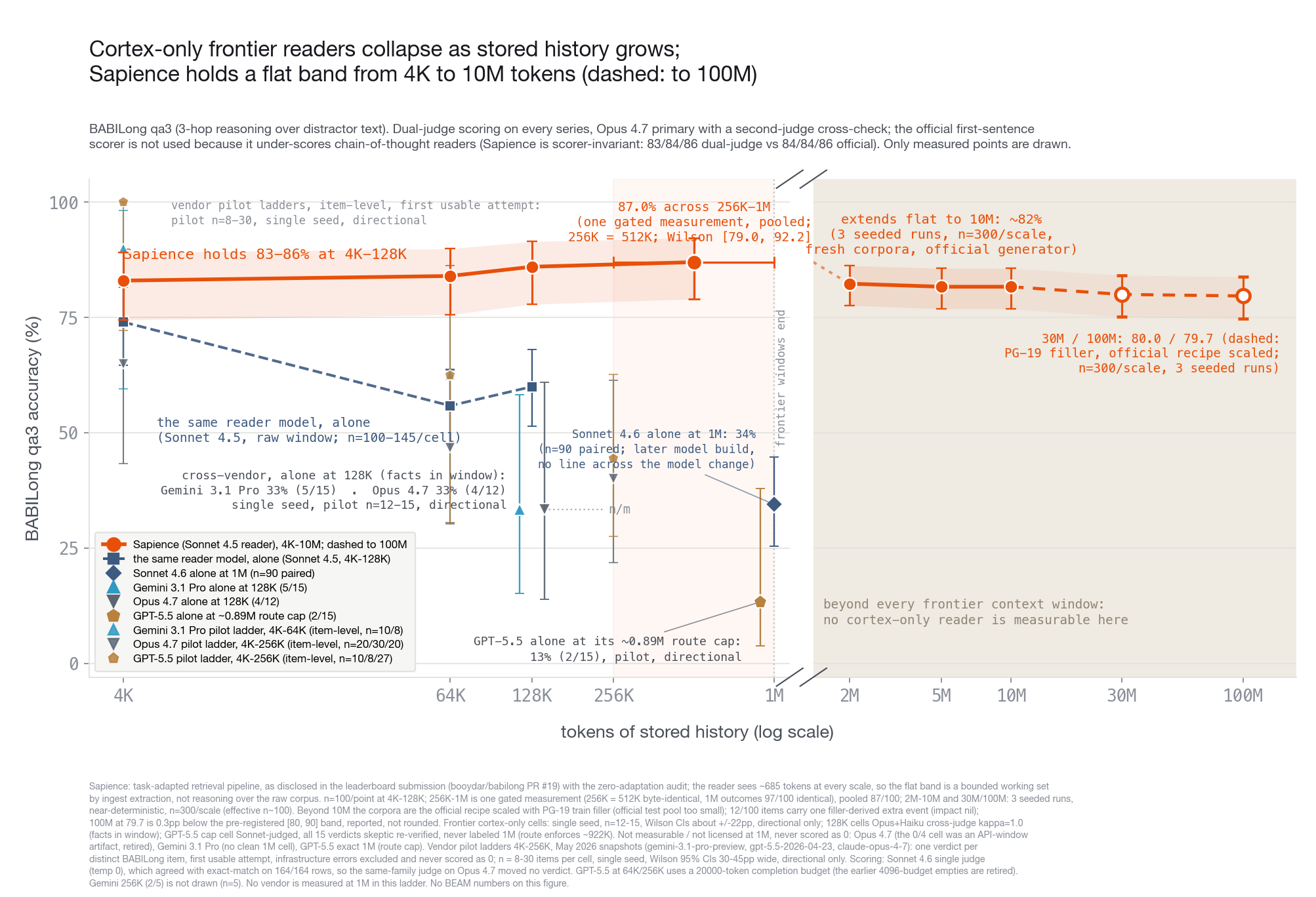
The measurement in one canvas: the same reader alone, and the cross-vendor pilots, decline toward their windows; through the store the band holds 83 to 87 to 1M and 81.0 to 79.7 from 2M to 100M (official scorer, 3 seeds, n=300 per scale), the model reading ~685 tokens per question. Beyond every frontier window, no cortex-only reader is measurable.
Every frontier model is trained once and then frozen, while the work it is meant to help with keeps moving. Scientific knowledge today travels in two containers: papers, fifteen pages, years late, with provenance no machine can read; and weights, where everything is absorbed and nothing travels out. We build a third box: continual learning at the system level, a store that learns from a lab’s work as it happens, with no retraining, in which the language model is a swappable part. The system carries what it learns across sessions, across model swaps, and, with consent and attribution, across people.
The problem it targets is measured. Across 50 documented cross-domain breakthroughs, a median 72 percent of the time from problem to solution went to search: the winning approach already existed, in another field or another lab, before validation began. Generation is scaling. Travel is not. A system that accumulates and connects what labs learn as they learn it attacks the search share directly; a larger generator does not.
The store. Work is distilled at capture into typed knowledge objects: a claim with its evidence, its condensed reasoning, provenance signed to an author, and typed edges to related claims. Encoding is gated by prediction error, so what contradicts or extends the store writes strongly and the redundant fades. When a new claim lands on an entity that already carries one, the two are linked at write time and the old claim is marked superseded; retrieval walks each chain to its head, so a stale value cannot outrank its replacement however similar it is to the question.
Consolidation. Offline, the system compacts specifics into structure: it clusters objects across sources and sessions and synthesizes higher-order claims that exist in no single stored record. Fast, gated capture feeding slow statistical integration is the division that complementary-learning-systems theory describes, and the mapping here is mechanism-level rather than metaphor. Science itself already runs the same loop in institutional form: journals as fast episodes, textbooks as slow canon, review and retraction as supersession.
The weight path. The store also schedules what an attached model learns. Consolidation renders a nightly training curriculum from what the store currently holds, new material interleaved with replay of settled knowledge, superseded facts excluded; a small adapter learns it beside a frozen base model. The update is reversible, since deleting the adapter restores the base exactly, and auditable, since the curriculum is inspectable text with per-fact provenance. This path is measured in the lab; what ships today is the store, retrieval, and consolidation over a frozen language model.
Matched protocol throughout: same language model, judge, and items per cell; multi-seed with stochasticity on; calibration holdouts excluded from every headline; item-paired statistics; mechanical ground truth instead of LLM judges wherever the task permits; pre-registration with published kill conditions, reported whichever way they land. Every number traces to a result file and the script that produced it.
| What is measured | Result | Protocol |
|---|---|---|
| Consolidation (aggregation gate) | +22.8 points over a compute-matched language-model counter on aggregation questions; exactly neutral on single-episode controls | Paper v4.3 result (3); 95% CI [+8.1, +38.2]; -3.3 on trend; single reader, synthetic instrument; broader semantic consolidation implemented but unestablished |
| Accuracy vs corpus scale | 83 to 87 percent from 4K to 1M tokens; under the official BABILong scorer 81.0 at 2M, 80.0 at 5M, 10M and 30M, and 79.7 at 100M; at 10M the same model reading its maximum 1M window scores 16.7 percent, and 0 percent where evidence lies beyond that window | BABILong qa3, 3 seeds, n=300 per scale, holdouts excluded; the 2M to 100M cells use the official scorer and PG-19 filler. The retrieved payload stays near-constant in size, so the flatness is scale-invariance by construction, not reasoning over 10M raw tokens unaided; the 0 percent is window arithmetic |
| Currency under change | +67 to 78 points over similarity retrieval on date-obscured supersession chains | 3 seeds, discordant-pair McNemar. Steelman control: hand-ordering the same retrieval recovers parity, isolating write order as the signal the structure carries |
| Retention through weight updates | Consolidation-scheduled replay retained 47 to 75 points more prior knowledge than sequential fine-tuning while learning the new domain as well or better, across two model families, three seeds each. Superseded facts are never rehearsed back in: 0/81 stale probes | Pre-registered, controlled; small adapter beside a frozen base. Lab result, not yet in the product |
| Structure itself, into weights | Replaying structured objects beats replaying the same content as raw prose by 10 to 12 points at a matched token budget | 3 seeds, pre-registered; content held constant, representation varied |
| Multi-hop vs strong retrieval | 46.4 vs 28.6 percent over a 1M-token haystack; on MuSiQue, +32 to +48 points in-window by hop count | Haystack cell: n=56 x 3 seeds, matched language model and judge, leakage-clean. MuSiQue: official exact match, no LLM judge; direction reproduces on a second model family; 5-hop remains unsolved |
| Coding, real git history | +30 to 65 points (question accuracy) over every store-less baseline on Repo-Evolution: currency and supersession questions over four production repositories | Gold derived mechanically from git, no LLM judge; a language model given no history answers 0 of 77, screening out parametric contamination; the margin holds with an 8B language model, so the store, not the model, resolves the answer |
| Pre-registered null | Within a window, single shot, static corpus: tie with a frozen frontier model plus strong retrieval, +0.00pp held-out, p=1.0 | Losing condition published before the run. The advantage begins where facts change, evidence exceeds the window, or work accumulates; it is absent where none of those hold |
Both directions ablated. A single-pass language model over the same store collapses by roughly 90 points, and the same language model without the store scores 0 percent at 10M: neither the scaffolding alone nor the model alone produces the result. A reasoning-tax control on competition math found none at n=30 (50.0 percent with the store vs 46.7 alone), a smoke test that resolves only a large tax.
Known failure modes. Trajectory-style questions, reconstructing the path of changes rather than the current head, score 0 to 13 percent and are unsolved. Strict event ordering scores 0 percent under the strict scorer. The weight path is the least mature mechanism in the system. And the one benchmark family we trail is single-document QA, where every fact is already in the prompt and the store has nothing to add.
The design point is deliberate: state outside the model rather than internalized in recurrent parameters, so it survives model swaps, carries provenance, and can be inspected and corrected. The two points bridge rather than compete, since the consolidation path moves what has stabilized in the store toward the weights. As for incumbents: training on users is the model business, and attribution would price it; persistence features from the labs are single-vendor by construction, and a platform tied to one model cannot be the neutral layer across all of them; and the slow part is not the code but the accumulated store, months of per-lab history with its supersession record, which exists only where the work happened. Adjacent tools improve the choosing step, which snippets to hand the model; the failures measured above happen earlier, at the keeping step, where write order, supersession, and provenance are discarded at ingestion and no retriever recovers what ingestion threw away.
Nine university labs run the system end to end today, and we are customer zero: this raise was run through the product. The store is cross-vendor in live use, so a claim recorded in one vendor’s session answers a question asked through another’s, with authorship attached. Identity is anchored to ORCID; signed LOIs with two major scientific publishers.
AI today generates; what it cannot yet do is connect. Sapience is the connective layer: one living memory that connects your sessions to each other, your AIs to each other, you to your AIs - and, with consent, you to other people. Most network products are worth nothing until the network shows up; this one is at its most useful on day one, alone - the memory and long-context reasoning above are the single-player product, and the network compounds on top. And the network starts at two, not at a million: users connect their Sapience with coworkers, partners, and friends on day one - one sentence, and one yes - so the first network anyone needs is one they already have. It is not several products stapled together: the same knowledge object that gives one person's AI memory - a claim with its evidence, its reasoning, and a name attached - is the object that lets two people's AIs connect, so matching, consent, and attribution are properties of the substrate rather than features beside it. Ultimately, the network is the thing we are building.
The ask is $40 to 60 million, weighted to senior research and engineering hires. The architecture paper is at spnc.ai; the full benchmark record, methodology, and reproduction materials are in the data room at partners.coretx.ai.